

Hercules was a Peloponnesian hero, while according to mythology the gods might lived on Mount Olympus, but were as well staying and worshiped in temples in the Peloponnese: Zeus was born in the holy mountain of Arcadia, the Lykaion term, Hera was the patron saint of Argos, Neptune was worshiped in Isthmia, while he was also mentioned in Pylos, Athena was glorified as Alea in Tegea and as Panachais in Patras, and finally Apollo lived in Amykles, while he was worshiped, with the epithet Epicurean, at the Arcadian Bassae.
ANCIENT OLYMPIA (WORLD HERITAGE UNESCO)

Olympia, site of the Olympic Games in classical times, has been inhabited since prehistoric times. In the 10th century BC, it became a centre for the worship of Zeus – here were his Temple, as well as the gold and ivory statue – the masterpiece of the Athenian sculptor Phidias, which was known in antiquity as one of the Seven Wonders of the World. In addition to temples, there are the remains of all the sports structures erected for the Olympic Games (the stadium of 45,000 seats with its monumental entrance and the platform of the Jury, the gymnasium), the monument of Altis – the sanctuary to the gods, which has one of the highest concentrations of masterpieces from the ancient Greek world- , as well as ancient buildings, conference rooms etc. The Archaeological Museum of Olympia – one of the most important in Greece – presents the long history of the most celebrated sanctuary of antiquity and contains finds from the archaeological site of Olympia. Among the many precious exhibits, for which the museum is famous, the Hermes of Praxiteles, the Nike of Paionios, the sculptural decoration of the Temple of Zeus , Zeus and Ganymede and the helmet of Miltiades.
MYCENAE AND TIRYNS (WORLD HERITAGE UNESCO)
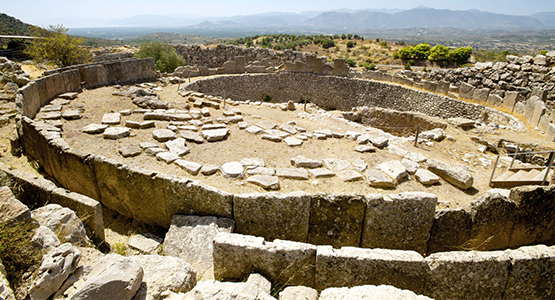
The archaeological sites of Mycenae and Tiryns are the imposing ruins of the two greatest cities of the Mycenaean civilization, which dominated the eastern Mediterranean world from the 15th to the 12th century B.C. and played a vital role in the development of classical Greek culture. At Mycenae ‘Rich in Gold’ – the kingdom of mythical Agamemnon, first sung by Homer in his epics – Great Cyclopean walls (with their original height estimated to be 12m.) surround the almost triangular acropolis, while impressive achievements of the Bronze Age are :the Lion Gate (the sole surviving monumental piece of Mycenaean sculpture, as well as the largest sculpture in the prehistoric Aegean), the Grave Circles A and B, the royal tholos tombs (with first and foremost the Treasury of Atreus) and the underground tanks for water supply of the city in case of siege – unique to the prehistoric era. Mighty Cyclopean Walls fortify Tiryns (about 15km SE of Mycenae), as well – that led Homer to call it ‘well-walled’ in the Iliad. The Mycenaean citadel which covers an area of approximately 20,000 sq. m., is built on a low rocky knoll of 16 meters. In the upper acropolis, the palace complex is preserved, while the sanctuary of Hera – one of the most famous Greek sanctuaries – was built on the ruins of the ancient city, in the 8th century.
EPIDAURUS (WORLD HERITAGE UNESCO)
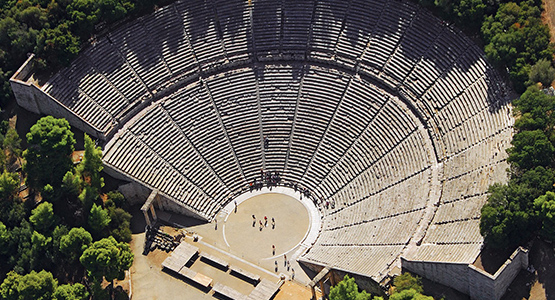
The Sanctuary of Asclepios at Epidaurus was the brightest healing center of the ancient world. Asclepios, son of Apollo, was the most important healer god of antiquity and his cult started there for the first time in the 6th century. His authority brought to the sanctuary great financial prosperity, which in the 4th and 3rd centuries BC. enabled the implementation of an ambitious building program for the construction of monumental buildings for the worship (theTemple and the altar of Asklepios, the Tholos (Dome), the Abaton, etc.), and later, of buildings mainly secular in character (the Theatre, the Ceremonial Hestiatoreion, the Baths, the Palaestra, etc.). The theater, with a capacity of 13 -14 thousand spectators, is famous for its acoustics and is considered as one of the purest masterpieces of Greek architecture. From the ancient sanctuary, there are preserved remains of bath facilities, the Katagogio, the sanctuary’s ornament (a large guesthouse with 160 rooms rooms for the accommodation of patients and their escorts), the Hestiatoreion(initially considered a high school), the Baths, the Stadium.
TEMPLE OF APOLLO EPICURIUS (WORLD HERITAGE UNESCO)

The famous temple dedicated to the god of healing and the sun, was built in the mid 5th century at Bassae (14km south of Andritsaina), at an altitude of 1.130m., in the lonely heights of the Arcadian mountains between Elis, Arcadia and Messinia. The temple, which has the oldest Corinthian capital yet found, is attributed to Iktinos, the architect of the Parthenon, and combines Ionic, Doric, and Corinthian elements with the signature daring architectural features of its creator. Not just a house of worship dedicated to Apollo – it is the only temple in the Greek territory (and perhaps the entire world) that rotates around an axis. It remained well-preserved over the centuries, thanks primarily to its isolation, and is considered as one of the finest surviving monuments of classical antiquity (and the first in Greece to be included in the World Heritage of UNESCO).
ANCIENT MESSENE

Ancient Messene (34km from Kalamata) – built according to the ” Hippodameian ” planning system based on the virtues of the democratic constitution- is the best preserved Hellenistic city in the country and one of the greatest cities of antiquity in terms of size and form. The excavations at the western foothills of Mount Ithomi—the strongest natural and artificial fortress of Messinia – are ongoing, but have already revealed all the secular and sacred buildings described by Greek traveler Pausanias around 155 AD: The Arcadian Gate, the Theatre, the Arsinoe Fountain, the Agora(market) and the Temples of Zeus Soter and Poseidon, The Asklepieion, The sanctuary of Demeter and the Dioskouroi, the Cross Road and The Hierothysion, as well as the remains of the fortification walls. The Archaeological Museum of Ancient Messene houses findings of the excavations: sculptures, terracotta figurines, votive plaques, pottery samples, etc.
PALAMIDI – BOURTZI

Nafplion, the capital of the First Hellenic Republic in 1827, is crowned by the mighty ramparts of the Palamidi Fortress, the famous castle east of Akronafplia. Nestled on the crest of a 216-metre high hill, the fortress was built by the Venetians in 1687. One may visit by car or climb the steps (there are 857 steps in the winding stair from the town to the fortress, even though locals claim there are 999…), and enjoy the impressive view of the city and the Bourtzi. The castle of Bourtzi (from the Ottoman Turkish word meaning “tower”) is located on a small island in the middle of the harbour of Nafplio and serves as the city’s landmark. Initially a Byzantine church; the Venetians completed its fortification in 1473 to protect the city from pirates and invaders from the sea. Until 1865 it served as a fortress. It was then transformed into residence and from 1935 it served as a hotel. Nowadays, it is mainly a tourist attraction (visited by boat), hosting occasionally parts of the Summer Music Festival.
MYSTRAS (WORLD HERITAGE UNESCO)

The story of the Castle Town of Mystras (6km from Sparta) begins in 1249, when William II of Villehardouin, Prince of Achaea, resolved to build a great castle on the top of the 620 m hill overlooking Sparta. Reconquered by the Byzantines – according to the legend the last Byzantine emperor Constantine XI Palaeologus was crowned in the cathedral dedicated to St Demetrios by the local bishop in 1449 -, then occupied by the Turks and the Venetians, the city was abandoned in 1832 with the foundation of the modern city of Sparta by King Otto, leaving only the breathtaking medieval ruins, standing in a beautiful landscape. The ruins of the “wonder of the Morea” offer the image of a city with a brilliant destiny that was deserted by men and threatened by the return of encroaching vegetation, which is splitting the walls and covering the slopes, thus destroying here and there fragile traces of history.
ANCIENT CORINTH

The site of ancient Corinth was first inhabited in the Neolithic period (5000-3000 BC), and flourished as a major Greek city from the 8th century BC until its destruction by the Romans in 146 BC. It was then rebuilt as a Roman city under Julius Caesar and prospered more than ever before. The Apostle Paul visited Corinth in 51-52 AD and later wrote two letters to the Christian community at Corinth. Nowadays, the ruins of ancient Corinth are spread around the base of the rock of Acrocorinth; extensive excavations have brought to light the Roman Marketplace (Agora), the Theatre, theAsklepieion, the Peirene Fountain, as well as cemeteries, temples, shops, galleries, spas, etc. The most notable ruin and one of Corinth’s major landmarks is the Temple of Apollo, built in 540 BC. The Archaeological Museum of Ancient Corinth contains collections of prehistoric finds, various items ranging from the Geometric to the Hellenistic period, Roman and Byzantine finds, sculptures and inscriptions, as well as artifacts of religious interest.
PALACE OF NESTOR
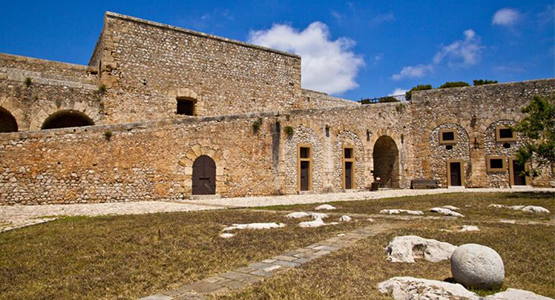
The Palace of Nestor, at the top of the hill of Epano Englianos (17 km north of Pylos), was built in 13 century BC; the site is the best-preserved Mycenaean Greek palace discovered. The palace is a complex of various buildings, consisted of a total of 105 ground floor apartments. It has four main buildings (SW building, central building, NE building, and wine store) and some smaller ones. The most important compartments are the big rectangular “throne room” with its circular hearth, the room with the clay bath tub and the ceramic stores with their numerous storage vessels. The walls of the palace were decorated with fine wall paintings. The thousands of clay tablets in Linear B’ script found in the “Archive” illuminate the multiple functions and transactions which took place there. These texts proof that Linear B’- the first script in the world with syllables, which was deciphered by architect Michael Ventris – is the earliest known Greek script.
CASTLE OF METHONI & CASTLE OF KORONI
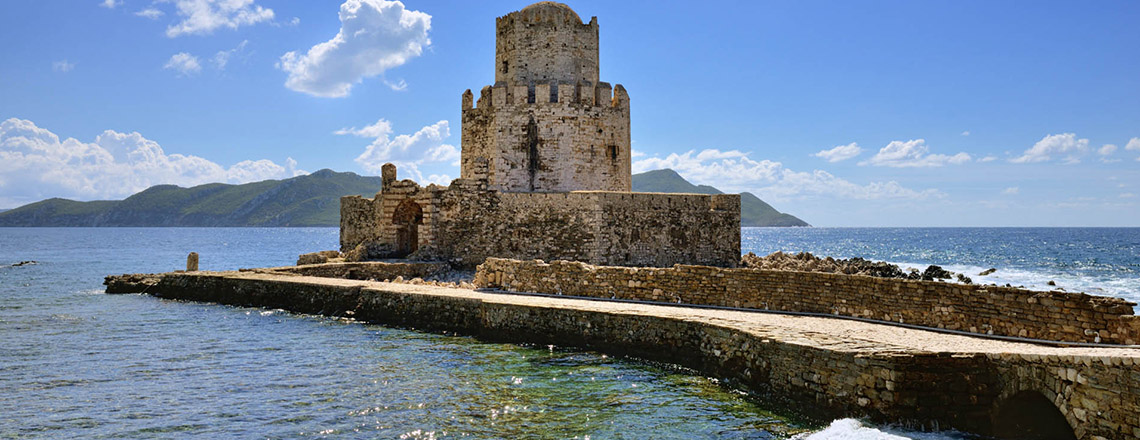
In the northest part of the west coast of the Peloponnese, lies the great fortress of Methoni – one of the largest and most impressive castles in the Mediterranean. The small peninsula, that was already fortified from the 7th century, was used until 1204 as a Byzantine fort. It was conquered by the Venetians, the Ottoman Turks, and again the Venetians until 1829 when the French general Maison freed the town together with others in the Peloponnese. Nowadays the walls of the fortress, even though in ruins, continue to be impressive. In the castle there are remnants of urban and ecclesiastic structures, the ruins of the byzantine church of St. Sophia, the ruins of Turkish baths, and the church of the Transformation of our Saviour, while to the south of the castle and on a small island, there is Bourtzi, an octagon fort with symmetrical walls. At a distance of approximately 25km., there is the Castle of Koroni, one of the finest examples of Venetian fortress architecture, built on the ruins of ancient Messenian Assini. It was erected in the 6th or 7th century A.D., and was captured by the Byzantines, the Venetians and the Turks until its liberation in 1828 by General Maison. The castle is ruined today but, the convent of holy John the Baptist, the ruined Byzantine temple of St. Sophia, the church of St. Haralambos, the hewn tombs, Venectian reservoirs, Turkish baths and the magnificent “domes” are preserved.